
Initially published on Forbes December 10, 2025
As we close the third year of AI’s mainstream arrival inside organizations, one thing has become unmistakably clear. The excitement around generative tools has not translated into widespread success. Research after research is showing that only a small portion of enterprise AI initiatives are achieving measurable value. Most companies are deploying pilots, running experiments, and adding new tools to old workflows, but very few are turning these attempts into real transformation.
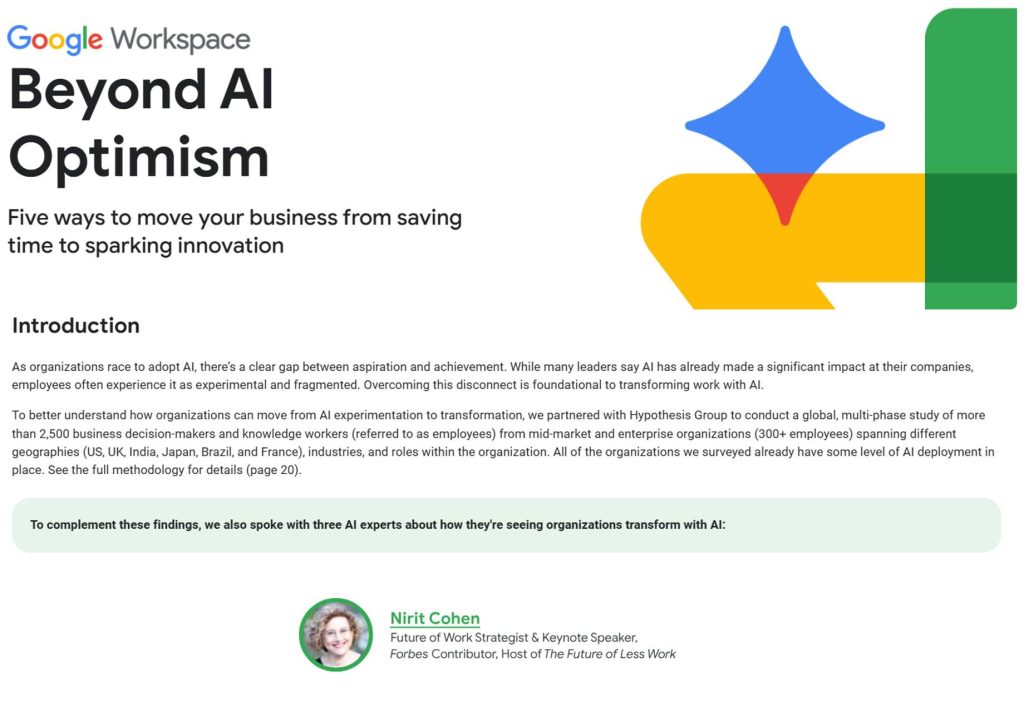
A new Google Workspace study “Beyond AI Optimism” reinforces this pattern. It finds that only 3 percent of organizations have reached a stage where AI genuinely reshapes how work gets done. This finding does not stand alone. It joins a growing body of evidence from across the industry. A recent MIT Media Lab analysis reported that 95 percent of generative AI pilots fail to deliver clear ROI or productivity gains. McKinsey’s 2025 “State of AI” survey also found that only a relatively small front-runner group captures most of the business impact while many others struggle to scale pilots and embed AI in core workflows.
Together, these findings paint a consistent picture. The problem is not the technology. It is the gap between enthusiasm and execution, between what leaders hope AI will unlock and what their organizations are structurally prepared to support.
That gap tells a larger story about the future of work. Technology is advancing quickly, but the systems around it are not. Google’s research reveals a striking disconnect between leaders and employees. Executives overwhelmingly believe AI is already delivering significant value. Employees report a very different reality. They use AI daily, they know it matters for their future, but many do not feel prepared or supported by their organizations. Confidence, clarity, and trust have not scaled at the same pace as the tools.
Based on findings from Google’s research and a wider body of industry studies, five behaviors consistently distinguish the small set of organizations that achieve real transformation. These five elements form the backbone of what separates the top 3 percent from the rest. They are not technology advantages. They are leadership choices, cultural behaviors, and workflow decisions that together create the conditions for successful enterprise AI implementation.
Here are the five patterns that consistently show up in the most successful AI transformations:
1. Treat AI Strategy as an Ongoing Enterprise Priority
The most advanced organizations do not frame AI as a project or pilot. They maintain an ongoing strategy that evolves as tools and capabilities mature. They define what success looks like, set clear proof points, and adjust direction as their understanding deepens. They also map how AI fits into broader business goals. This creates the foundation for alignment, which becomes essential as teams move from experimentation to scale. Companies that win with enterprise AI treat strategy as a continuous process.
2. Build an AI-Ready Culture Across the Organization
Highly transformed organizations integrate AI into daily work norms. They invest in training that goes beyond basic tool usage and focus on building confidence, curiosity, and shared learning. Managers talk openly about what AI changes in the flow of work and what it unlocks for the team. This cultural permission structure reduces the fear that often comes with automation by giving employees a role in shaping the work. People in these environments are more engaged because they understand not only how to use AI but also why it matters.
3. Redesign Workflows for AI-Driven Work and Human Expertise
Instead of automating around the edges, the leading organizations take the time to define which tasks should be automated, which require human judgment, and how the two fit together. They redesign roles to reflect this new balance. This reduces friction and helps employees shift their effort toward work that creates higher value. It also strengthens collaboration because people know where AI fits in the chain and where human expertise is essential. Enterprise AI begins to deliver meaningful impact once workflows are redesigned to reflect the evolving roles of people and technology.
4. Empower Distributed AI Champions to Accelerate Adoption
In successful organizations, AI does not stay in the hands of a central team. It spreads through employees who discover effective uses and share them across functions. Leaders identify these early adopters and give them the permission and platform to influence others. This creates a network of advocates who accelerate organizational learning. Knowledge moves more freely and momentum builds horizontally, not only from the top.
5. Embed AI Into Daily Workflows to Drive Real Enterprise Impact
The top-performing organizations select tools that fit naturally into existing workstreams rather than building parallel systems. AI becomes part of how people communicate, create, and decide, not a separate destination. It lives inside email, documents, meetings, and shared workspaces. This reduces switching costs, increases adoption, and allows AI to shape the rhythm of daily work. Enterprise AI succeeds when it is embedded into the flow of work.
What stands out in the research is how intentional the top 3 percent are. They do not wait for employees to figure things out on their own. They do not assume productivity gains will translate automatically into business results. They connect technology to purpose, workflows to value, and people to the process of change. That combination becomes a multiplier. These organizations report higher innovation, stronger creativity, faster development cycles, and more meaningful work for employees.
As leaders prepare for 2026, the message is clear. AI transformation begins with the decisions leaders make about people and work, long before it involves technology. Companies that build these organizational foundations will find themselves moving into the top 3 percent sooner than they expect. Those that treat AI as a software add-on will keep playing catch-up.
![large-AX1A2125-2[1]](https://workfutures.niritcohen.com/wp-content/uploads/elementor/thumbs/large-AX1A2125-21-qxa6npndw0r0l24lsji63xd02f4z7mz8t0qq0g5234.jpg "large-AX1A2125-2[1]")