When AI stops being experimental and starts acting inside everyday workflows, the conversation about work changes completely. The question is no longer which tools to deploy, but who gets to redesign how work actually happens.
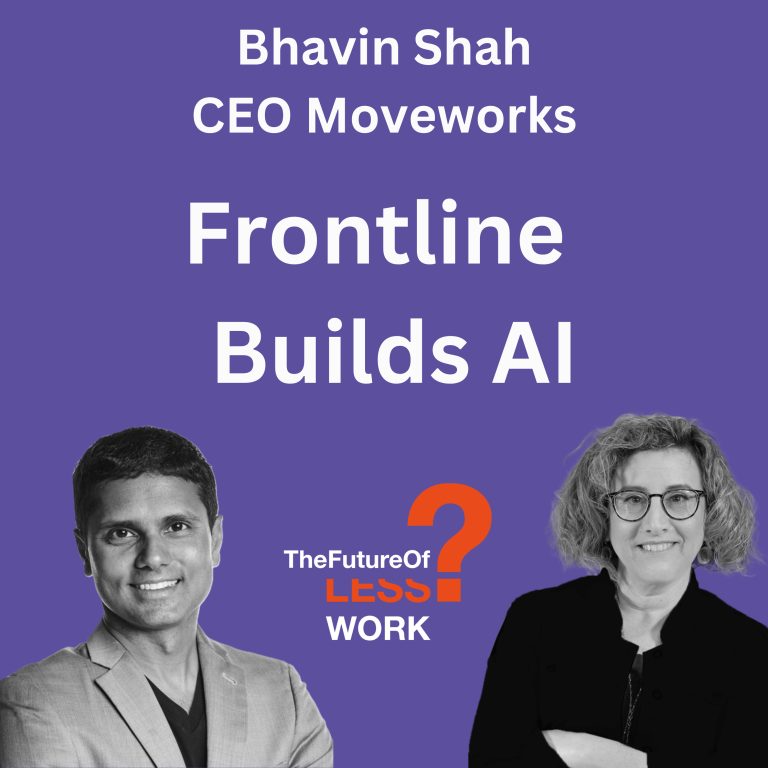
In this episode of The Future of Less Work, host Nirit Cohen sits down with Bhavin Shah, co-founder and CEO of Moveworks, to explore what happens inside organizations once AI moves beyond summaries and copilots into real action. Drawing on what he sees across large enterprises, Bhavin explains why the next phase of AI innovation is being driven not by executives or engineers, but by frontline employees who know exactly where friction lives.
Together, Nirit and Bhavin unpack why top-down AI strategies often stall, how non-technical teams are quietly rebuilding broken workflows, and why the most important metric for AI success is no longer outputs generated but actions completed. They explore the shift from fighting shadow IT to embracing “sanctioned autonomy,” where leaders provide guardrails and platforms, then step back and let innovation emerge from the work itself.
The conversation also looks ahead at what this means for trust, leadership, and careers. As agents take on routine work, roles begin to level up, managers become designers rather than approvers, and influence starts to flow from those who improve systems rather than those who control them.
If you’re wondering who becomes the architect of work when automation is accessible to everyone, and how organizations move from AI that talks to AI that truly changes outcomes, this is a conversation you won’t want to miss.
Guest Information:
Bhavin Shah is the CEO and co-founder of Moveworks (recently acquired by ServiceNow), the agentic AI assistant platform for the enterprise. He’s spent his career building technology that actually solves problems for people at work. Raised in Silicon Valley and shaped by early exposure to tech pioneers, Bhavin’s journey took him from collaborating with Dr. Sally Ride at UC San Diego to leading impactful projects at LeapFrog, where he helped bring educational tech to children worldwide, extending its impact with a prenatal health education program for women in Afghanistan. He later founded Refresh.io, which was acquired by LinkedIn in 2015, before launching Moveworks in 2016 to help organizations automate workflows and boost productivity using AI.
Today, over 350 enterprises, including 10% of the Fortune 500, and over 5.5 million employees rely on Moveworks.
Bhavin holds a B.S. in Computer Science from the University of California, San Diego and a Master’s degree in Education, Technology, and Business from Stanford University.
Chapters:
00:00 — Who Should Drive AI Transformation at Work?
01:29 — Why AI Innovation Is Coming From the Frontline
03:29 — Can Employees Redesign End-to-End Workflows With AI?
05:30 — How Agentic AI Connects Fragmented Enterprise Systems
07:46 — Is Shadow IT Becoming a Competitive Advantage?
10:06 — What Does “Sanctioned Autonomy” in AI Really Mean?
11:37 — Why AI Summarization Is No Longer Enough
13:30 — Can Organizations Trust AI That Takes Action?
15:31 — How Guardrails Replace Control in AI-Driven Work
17:27 — Will AI Fool Us or Make Us Smarter at Work?
18:45 — How Agentic AI Is Changing Non-Technical Jobs
19:49 — Does Automation Actually Level Up Human Work?
21:54 — How Much Work Can AI Really Eliminate?
23:47 — Why Companies Are Scaling Faster Than Ever With AI
25:29 — What Happens When Innovation Cycles Speed Up?
26:54 — What Question Should We Be Asking About the Future of Work?