What happens when AI moves beyond software and into the physical world—through robots and humanoid robots working alongside humans? How do organizations redesign work when machines don’t just support decisions, but actually execute tasks?
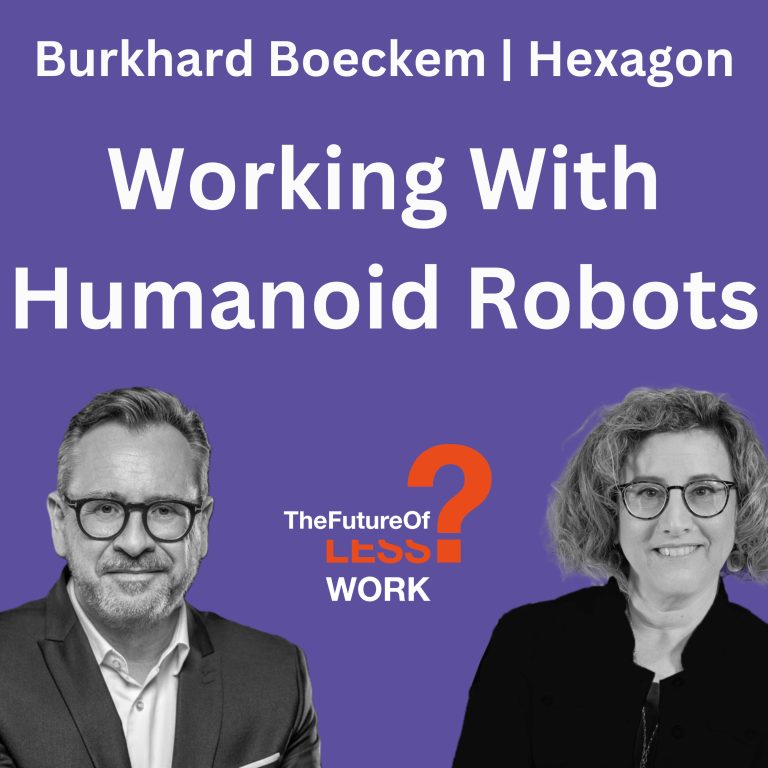
In this episode of The Future of Less Work, host Nirit Cohen sits down with Burkhard Boeckem, Chief Technology Officer at Hexagon, to explore how “physical AI” is entering real-world workplaces from factories to autonomous systems.
They discuss how work is shifting from individual roles to human-machine systems, why trust becomes the central challenge when AI operates in physical environments, and what it takes to bridge the gap between what these technologies can do in theory and what actually works in practice.
Guest Information:
Burkhard Boeckem is the Chief Technology Officer (CTO) of Hexagon, where he leads the company’s innovation goals for a future shaped by autonomy, robotics, and spatial intelligence. Burkhard leads Hexagon’s technology evolution toward autonomous systems, integrating artificial intelligence, edge computing, LiDAR, and 5D digital twin capabilities into scalable technology platforms that support complex industrial ecosystems. Most recently, Burkhard started and set up the team that developed the company’s first humanoid robot, AEON, built for industry, launched in June 2025.
Links:
Hexagon’s Robot Generation Report: https://hexagon.com/robotics/the-robot-generation
Chapters:
00:00 — What Is Physical AI In The Workplace?
01:26 — How Is Physical AI Different From Automation?
04:07 — What Will Humans Do When Robots Can Execute Tasks?
06:06 — Will Humanoid Robots Replace Factory Workers?
10:06 — Why Do Robots Need To Look Like Humans?
12:58 — How Would You Build An AI-First Factory?
14:38 — What Is The Human Role In AI-Powered Workplaces?
17:49 — How Are Companies Using Humanoid Robots Today?
20:31 — How AI And Robots Change Factory Workflows
22:18 — What Will It Feel Like To Work Alongside Robots?
25:26 — Why Is Trust The Biggest Challenge In Physical AI?
28:05 — Why Physical AI Is Harder Than Digital AI
31:29 — What Questions Should We Ask About The Future Of Work?
33:13 — How Should Schools Prepare Humans For AI And Robots?